
Investment Strategies for Beginners: A Guide for BBA Finance Students
- Dr Poonam Budhlani (Assistant Professor- BBA)
- August 26, 2025
- Educational

Investment Strategies For Beginners are not so much about earning money as establishing wise financial behaviors early on. For BBA Finance students, acquiring knowledge in investment provides both academic value and practical experience that can foster lifelong financial independence. The sooner you start, the better you are with compounding and steady growth. This BBA Finance Investment Guide introduces what investing is, why it is important, and offers step-by-step practical advice on how to start.
Why is Investing Important for BBA Students?
- Beats inflation: Money just being deposited in a savings account loses its value due to inflation, but with investments, it would grow faster and preserve the purchasing power of the individual.
- Accumulates long-term wealth: With compounding, small investments initiated during college days can expand a lot by the time you graduate and continue to develop for the rest of your life.
- Applies learning in class: Principles such as stocks, bonds, and portfolio management at this stage may be converted from theory to practice.
- Sensitizes decision-making: Investment choices include examining companies, markets, and risk factors, abilities that are crucial for a finance career success.
What are the Best Investment Options for Students
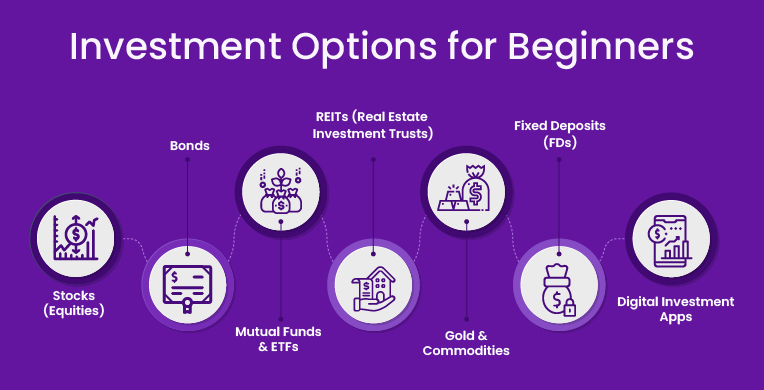
Here are the best investment plans for beginners that can help students to start building wealth early and gain practical financial knowledge.
Stocks (Equities): Buying company stock with growth potential. Very high risk; very high returns potential.
Bonds: Safer than stocks; fixed interest returns, good for stability.
Mutual Funds & ETFs: Diversified and easy for beginners, best for students.
REITs (Real Estate Investment Trusts): Enable exposure in real estate without massive capital.
Gold & Commodities: A Traditional haven when you need protection from inflation.
Fixed Deposits (FDs): Very low risk, assured returns—it’s best for risk-averse beginners.
Digital Investment Apps: Platforms that enable you to start with as little as ₹500–₹1,000.
Step-by-Step Investment Plan for Beginners
Clarify Your Goals
Are you saving for higher education, travel, retirement, or startup capital?
Categorise into:
- Short-term (<3 years)
- Long-term (>5 years)
Allocate quantities and periods to each.
Assess Risk Tolerance & Capacity
- How would you feel: what if my investments went down 20% from their current inflated value?
- Risk tolerance = your acceptable comfort level.
- Your risk capacity is how much you can afford to pay based on stability, savings, and income.
Build a Strong Financial Foundation
- Being debt-free first.
- Always keep an emergency fund ready (3–6 months’ expenses).
Open an Investment Account
- Options: broking accounts, retirement savings accounts, or student-friendly platforms.
- It’s possible to set up apps where you can invest even as little as ₹500 – ₹1,000.
Start Small & Stay Consistent
- Start with your monthly budget at ₹500 – ₹1,000.
- Dollar cost average (investing on a consistent monthly basis).
Diversify Your Portfolio
- Use various combinations of bonds, stocks, and other industries.
- To reduce the investment risk associated with single stocks, use mutual funds or exchange-traded funds (ETFs), which have reduced risk compared to single stocks.
Monitor & Rebalance Regularly
- Check every 6 months.
- Sell some of the overperformers and add to underweighted assets.
Stay Informed, Not Reactive
- Follow financial blogs and markets.
- Prevent panic-selling in volatility.
7 Best Investment Strategies for Beginners
These are easy but effective investment strategies for beginners that can be adopted by any BBA finance student to make a robust financial future.
- Start Early & Small – Begin with as little as ₹500–₹1000 monthly.
- Establish Specific Objectives – Establish short- and long-term objectives.
- Know Your Risk Tolerance – Invest where you’re comfortable.
- Diversify Your Portfolio – Diversify between stocks, bonds, funds, and gold.
- Choose low-cost Options – Prefer index funds & ETFs.
- Invest Periodically – Do SIPs instead of attempting to time the market.
- Review and Rebalance – Review and rebalance your portfolio regularly.
What are the Common Investment Mistakes to Avoid as a Beginner?
Common Investment Mistakes to Avoid as a Beginner
Timing the Market – Do not try to guess what are highs and lows are; always focus on longer-term investments.
Lack of Diversification – Do not invest in one company or industry at any time.
Fee & Transactional Ignorance – Higher costs make low returns; utilize low-cost alternatives.
Investing without Goals – Goals are better financial choices.
Emotional Decisions – Avoid panic-selling or over-investing due to market hype.
Ignoring Risk Tolerance – Invest within your comfort and financial capacity.
Skipping Portfolio Reviews – Review and rebalance once in 6–12 months.
By avoiding these common mistakes, beginners—especially BBA finance students—can build a strong, stress-free investment journey.
Investment Strategies for Beginners serve to take away the illusion of rapid wealth generation. Don’t forget that investing is a marathon, not a sprint. Following these strategies, particularly as students, you build not only your academic foundation but also a basis for financial development throughout your lifetime. The sooner you start, the more time compounding has to work in your advantage.
The rule is straightforward: begin early, begin with little, persevere, and never stop learning. Whether you are searching for ways to invest as a student or finding the best beginner investment strategies, persistence and patience will be rewarded.
Boost your study and career skills—check out our latest blogs.
Frequently Asked Questions on Investment Strategies for Students
Q1: What kind of work is best for students interested in studying for a BBA in finance?
Career opportunities for graduates with a Bachelor of Business Administration in Finance include
- Wealth Advisor
- Financial Analyst
- Investment Banker,
- Corporate Finance Associate. If they want more options after graduation, most of the students opt for an MBA or a CFA.
Q2: How to start investing as a student in India?
In India, the most effective manner for students to start investing is by paying off debt, creating a Demat/broking account, and investing small amounts of money monthly in inexpensive index funds or ETFs. Groww, Zerodha, and Choice Equity Broking mobile applications help beginners.
Q3: How do you become an investor?
To begin with, the best investment choices are usually index funds, ETFs, and SIPs (Systematic Investment Plans). The best way for a beginner to start is to start small, diversify, and systematically invest at regular intervals.
Q4: What is the expected income for a student pursuing a BBA in finance?
In India, the best BBA Finance graduates who work in investment banking, corporate finance, or international roles can make more than ₹25–₹30 LPA. With further qualifications like the CFA or MBA, salaries rise aggressively.
Q5: How can investing help you in the future?
Investing makes an individual economically independent, insulates one from inflation, and builds wealth in the long run. It teaches students to manage money at an early age and provides them with a strong platform for the future.
Blog & Article
Elevate Your Knowledge, Illuminate Your Future
Lorem ipsum dolor sit amet, consectetur adipiscing elit.